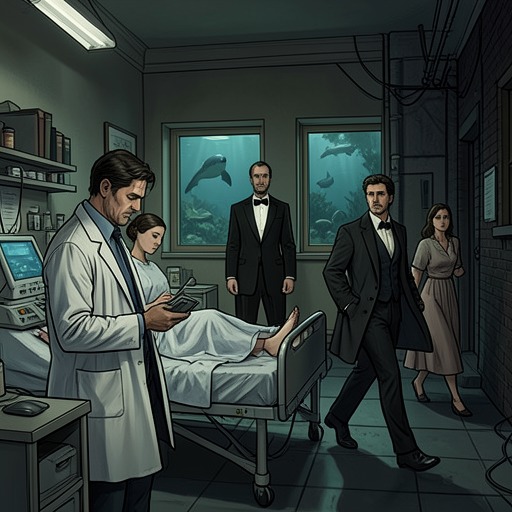
Gogol Brain-Chip Downloads
Made for LoveGogol Brain-Chip Downloads are a recurring process tied to the chip in Hazel’s head, turning a technological intervention into a timetable that governs escape, medical danger, and uncertainty. The excerpts establish that Hazel’s downloads can be watched, that another is expected at noon, and that Jasper’s injection is intended to disable the chip. They do not explain precisely what the downloads contain or how they operate, but their predictable return makes them an immediate threat in Hazel and Jasper’s attempt to get her away from Byron.
The Chip and the Recurring Process
The rabbit woman describes Hazel as having a chip in her head and offers Jasper a syringe that will deactivate it. She connects the proposed rescue to Jasper’s own experience: Voda had altered his brain, she says, while Hazel’s situation is much worse. The exchange identifies the chip as something that can be acted upon physically, but the excerpt does not specify the technical mechanism of either the downloads or the deactivation.
The process is recurring rather than a single past episode. The rabbit woman has watched Hazel’s downloads, and she tells Jasper that he and Hazel should disappear before the next one. Hazel, too, treats its return as a concrete possibility: the following day, she expects a noon download and considers what to do if it happens. Its regularity gives the threat a clock. At the same time, the excerpts leave open what information a download carries and what happens during one; its significance here rests on its repetition, its observability, and the danger attached to its expected arrival.
Surveillance and Escape
The rabbit woman’s knowledge of Hazel’s downloads has practical consequences before Jasper even reaches the trailer. Based on what she has watched, she advises that the back sliding-glass door is the best entry point if nobody answers the front. Surveillance thus supplies a route into the immediate rescue, while also showing that Hazel’s private crisis has become legible to an outside observer. Jasper follows the advice in a fake parcel-delivery uniform, carrying the cooler with the syringe.
Once inside, Jasper finds Hazel beside a discarded pill bottle and initially believes she is dead. He considers calling for medical help, but the possibility of a hospital creates another danger: he fears Byron would be notified and take control of Hazel’s care. The rabbit woman has warned that hospitals should be a last resort if anything goes wrong. Jasper also worries that Byron’s round-the-clock surveillance would leave Hazel unable to make another attempt at suicide. The downloads therefore belong to a larger condition of monitoring and control, even though the excerpts do not establish that the download itself is the only means by which Byron tracks her.
The Injection and the Noon Deadline
When Hazel makes a gurgling noise, Jasper realizes she may still be alive. Unsure what immediate medical action to take, he decides to give the injection, reasoning that she will need it whether or not he calls an ambulance. Later, he tells her that the injection should disable the chip in her brain. He explains that the rabbit woman sent him and that they should leave before the next download. The intervention is therefore both a rescue attempt and an effort to interrupt the cycle that makes their location and timing dangerous.
Hazel’s first response is to warn that Byron will kill Jasper. She then turns to her father’s body and refuses to leave it behind: she fears Byron could use the corpse as cryogenic blackmail. The need to evade the next download does not erase this separate obligation. Jasper agrees to take the body and suggests they find a way to keep it cold. Their departure is shaped by two urgent demands at once: getting Hazel away before the anticipated technological event, and preventing Byron from taking possession of her father’s remains.
The Expected Download That Does Not Occur
At seven in the evening, Hazel and Jasper still have nearly seventeen hours before the expected noon download. Hazel asks whether they should split up, reasoning that if the chip is still functioning, Jasper would be safer if she did not know where he was. She even calculates that he could reach the other side of the world by the download time. Jasper instead offers to drive her farther away first. The timing turns a question of trust and proximity into a practical calculation of how much distance they can gain.
Hazel has brought several pill bottles and identifies taking more pills as her backup if the chip remains active. Later, as the expected time approaches, she stands by a running faucet in case the download makes her vomit. It does not happen, but she vomits anyway, treating the bodily response as an expression of emphatic gratitude rather than as evidence that the process has occurred. The scene supplies a limited but important outcome: this anticipated download is absent. It does not establish whether the injection alone caused that absence or whether Hazel’s chip is permanently disabled.
Narrative Significance
The downloads make technological control felt through anticipation. The threat is not described through a technical explanation; it appears in a route chosen from observations, an injection carried in a lunch-pail cooler, a deadline measured against the clock, and Hazel’s readiness to use the pill bottles again. The mechanism remains partly opaque, but its effects on decisions are clear. Jasper’s rescue depends on acting before the next cycle, while Hazel’s attempt to imagine a future remains shadowed by the possibility that the chip will still work.
The missed noon download offers relief without certainty. Hazel can begin moving away from the immediate crisis, yet the evidence does not resolve the larger question of whether she has escaped the system that made the downloads possible. That uncertainty preserves the process’s narrative force: even when the expected event fails to arrive, the timetable has already shaped where the characters go, what they fear, and what they are willing to do.